DesignFlow - Luna Bot
Role:
UI Designer
Timeline:
Feb 2025 - 4 Weeks
Skills:
→ Market Research
→ Wireframe
→ Visual Design
→ Prototyping
Team:
→ Myself
Project Overview:
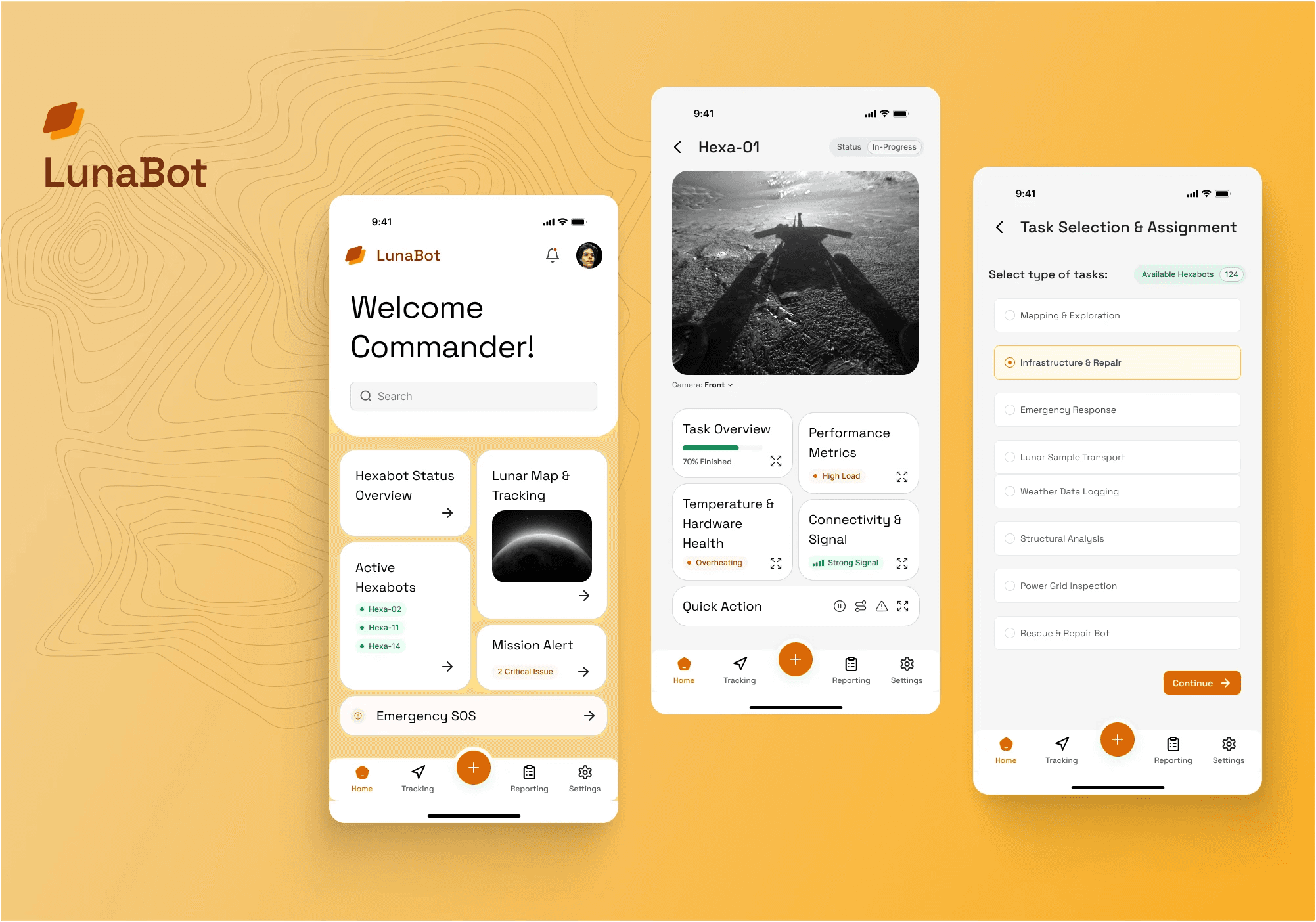
LunaBot was my entry for DesignFlow 2025, a design challenge organised by DesignFlow and powered by Bending Spoons. The brief: design a mobile mission control to track a fleet of bots and handle emergencies with speed and clarity. Over four weeks, I delivered 12 core wireframes and 3 high-fidelity screens covering homepage, bot-screen and task selection & assignment. Goals: My goal was to create great UI according to the breif that helps operators identify tasks and take the correct action in under 30 seconds on mobile.
Main Challenges:
Designing mobile mission control in a 4-week challenge meant defining triage success fast, cutting to essentials, and proving decisions with clear proxies.
Limited time (4-week sprint)
Solo build with a broad brief and no production data meant limited discovery and only lightweight validation.
The risk of overfitting to assumptions; forced strict prioritization of triage, escalation and resolution over nice-to-have telemetry views.
Idea generation under ambiguity
The brief was defined, but not the operator’s first 30 seconds, success criteria, or severity model.
High chance of solutioneering; I set explicit targets (proxy): identify top incident <30s, initiate correct action in ≤3 taps to anchor ideation.
Presentation for judging
Challenge format rewards clarity and speed over depth; judges see dozens of entries.
Impact: necessary to compress rationale into a crisp decision → trade-off → result narrative and show measurable proxies, not adjectives.
Process:
Understanding the brief
Translated the brief into two success targets: identify top incident in <30s; start the correct action in ≤3 taps (proxy).
Scoped to three flows with the highest judging signal: home-screen, Bot-Configuration screen and Task selection & assignment screen.
Defined non-goals to protect time: deep telemetry graphs, bot configuration, and user management.
Strategic alignment
Treated judges as stakeholders: optimised for clarity of decisions → trade-offs → results, not feature breadth.
Developed a design roadmap.
Modern UI and design system
IA: Map-first canvas with a persistent severity-ranked Incident Dock; list fallback for offline/low-signal states.
Tokens: two tiers (Critical, Attention) with color, icon, and haptic patterns; color not the only signal.
Action model: Single Emergency Action Sheet consolidating resolve, recall, pause, escalate with confirm + reason (auto-log).
Glanceable status: Bot peek card shows role, task, battery, connectivity, ETA, and 1–2 recommended actions.
Accessibility: 16pt base type, large targets, focus order defined; high contrast; supports one-hand reach.
Deliverables: 12 wireframes to map breadth; 3 high-fidelity screens for the hero flow and micro-interactions.
Presentation
Submitted 12 wireframes and 3 high-fidelity screens covering triage → escalate → resolve.
Each screen was annotated with Decision, Rationale, Trade-off, and Result (proxy) to make the thinking explicit.
Outcome:
I didn’t win the contest, and that’s fine. The real win was pressure-testing my process. I shipped 12 wireframes and 3 high-fidelity screens on a tight deadline, refined designs without compromising clarity.
Key Learnings:
Define the win on day 1. Set two measurable targets before sketching (e.g., <30s to identify, ≤3 taps to act — proxy) and cut anything that doesn’t move them.
Show breadth, then choose. Present 2–3 viable alternatives (list-first, split-view, map-first) and explain why they lost; judges reward structured exploration.
Prove impact, not effort. Annotate hero screens with Decision → Rationale → Trade-off → Result (proxy) and include simple before/after metrics (time, taps, errors).
In short: Design challenges are won with clarity, not volume. Define success up front, explore options visibly, then land decisions you can defend with quick, honest proxies.